I spend a lot of time scrolling. Instagram is where I mentally tune out, and instead mindlessly absorb visual data with varying rates of success.
I drool over vegan milkshakes which overflow sensually from bubbling mason jars, and peer curiously into the homes of people I’ll never meet. But when I found this illustration of two nimble little fingers tentatively checking for a pulse I had to click through and see where exactly they were born.
It was only then I learned about The Feels Club. I consumed every image and went full ham on a ‘liking’ marathon, completing my record-breaking sesh with a fangirl email to the account owner Chloe to ask for more details. Here’s what I discovered.
Who are ya? Chloe Webb, aged 24 based in Central Coast NSW, Australia.
Did you always knew you wanted to be an artist? It’s all still very new for me and I’m still constantly learning how to navigate the process of being an artist. Even just adjusting to the term “artist” itself is an ongoing process. And I think that has a lot to do with the fact that art was never something I ever saw myself pursuing, it was just this quiet thing I did when I was alone. Up until the point where it spoke to me so loudly, I could no longer ignore it.
As cliche as it sounds, art and being an artist was something that found me. It began to speak to me a whole lot louder in 2015 when I had been going through a pretty turbulent time with my mental health. In 2016 I became acutely aware that I wasn’t the only one going through the motions of mental illness and it shook me. Suddenly I saw the ugly, abrupt and heartbreaking veracity of depression’s toll first hand.
Everything spoke louder then. And it shook me, wide awake. I found myself taking pen to paper more than ever and I just knew I had to try to use my art for good. To let people know that it is entirely OK not always be entirely OK.
What is “The Feels Club” and what does it mean to you?
The name The Feels Club was my way of maintaining the purpose and honesty of the story behind it, but kind of making it a little more gentle and soft. I’ve always been cautious of the language of mental health and how it’s labelled, and I guess that’s just part of my own personal coping mechanism.
But also I find in doing so I can dis-empower the terms and turn it to something a little lighter and brighter, something that unites people. And speaking about it now wholeheartedly what The Feels Club is about. And the fact people can connect with it, that means everything me.
In your bio you describe yourself as ‘scribbling through the feels’. What’s the relationship like between your creativity and mental health?
I often describe depression and anxiety as being my invisible enormities. When I fall into a low and it happens, art and living creatively is how I pick myself back up again, because when I allow myself to take up the space between an inky pen and paper, I know for certain that there are bigger enormities inside of me, enormities that are so much bigger than anxiety and so much brighter than depression.
Do you find it hard to open up and be vulnerable in your artwork?
Absolutely. But I’ll always push myself to do it. Because there is an ugly stigma that exists around mental health and it must be dissolved. Everyday at least 6 Australians take their own lives and 30 Australians attempt. Suicide is the leading cause of death for young people aged between 15-25… this is an issue too big to continue sweeping under the rug, because quite frankly we’ve ran out of rugs big enough.
Lots of my readers suffer from mental illness and are looking for tips on how to manage their symptoms. Do you have any advice? I know all too well how absurd these next words will appear, but JOURNAL. Write it all down. My eyes basically rolled so far back in my head that I saw stars when I this was first suggested to me.
But with some hesitation I gave it go and I never looked back. The thing is with mental illness, the most common thing the people will say is “I’m here if you ever need to talk” and don’t get me wrong I’ll never take for granted the beauty of that offer. But more often than not, when you’re in the baffling thick of the big sad (another term I’ve found to dis-empower the beast) chances are you’re already feeling heavy and speaking that weight can sometimes be a gnawing mission within itself .
That’s where journaling made all the difference for me. Not only did it let me get it all out but it also allowed me to move past that guilty feeling when trying to actually talk about my feelings with actual humans. Writing in a book might feel small, when your feels are so big. But the process and practice of letting yourself let it all out is a huge step.
The best thing that I’ve found through blogging is an online community of like minded people. Have you found a similar support network through your art?
My goodness, yes, more than I ever could have imagined! There are so many extraordinary people out there sharing their stories and journeys. And more importantly they’re listening all the same. It’s such a comforting refresh. It makes me believe that bloody stigma doesn’t stand a chance.
How does social media and working online play into your mental health? Is it hard to disconnect?
I’m so glad you asked this question! It can be, for sure. Especially when I first began The Feels Club. I was feeling so nervous and passionate about doing it ,that I wound up in a feverish rush to make it all happen at once. I’d spend full days online trying to kick things into gear and just be left feeling so drained afterwards because a) Not only had I forgotten to eat but I’d actually forgotten there was an entire outside world. And b) the results were not instant.
These days I operate on a bit of a schedule to allow me some disconnect and so not to disregard my routine. Which has helped me view it differently – I can still be impassioned and driven without neglecting myself and my own self care. And I’m much more patient with just letting it be and letting things happen organically. It’s whole lot nicer that way!
How do you de-stress/unwind? Apart from art and writing… I’m lucky enough to live on a pretty magnificent piece of coastline, so the ocean is never far. Which is ultimate for me because slipping into the sea whatever the weather and getting all salty is just such a magic cleanse for me.
I also started Yoga last year, which was another thing I initially rolled my eyes at. But now I try to practice 1-2 times a day and while I’m still very much a beginner the results are pretty powerful.
What are you looking forward to for the rest of 2017
Making and releasing new art. Taking the leap of putting my writings and poetry into the world. Returning to the workforce and saving some funds for a bit of travel. Accepting love and giving love a little bigger. Smashing that damn stigma and just flowing with the journey wherever it leads me!
You should know by now that I’m really into talking about my mental illness. In fact, I think it’s pretty darn important that we ALL talk about it. We’ve been conditioned to stay silent on the subject for so long that we now need to shout EXTRA LOUD to make sure the world hears us when we say mental illness is real, and it needs to be taken seriously.
There are many ways you can choose to wear your mental illness on your sleeve. I suggest you wear it with pride. You’re a warrior, a strong-minded individual who is not defined by your diagnosis and if you’re comfortable, I urge you to start a conversation about mental illness.
What better way to wear it than on a fricking kick-ass t-shirt?
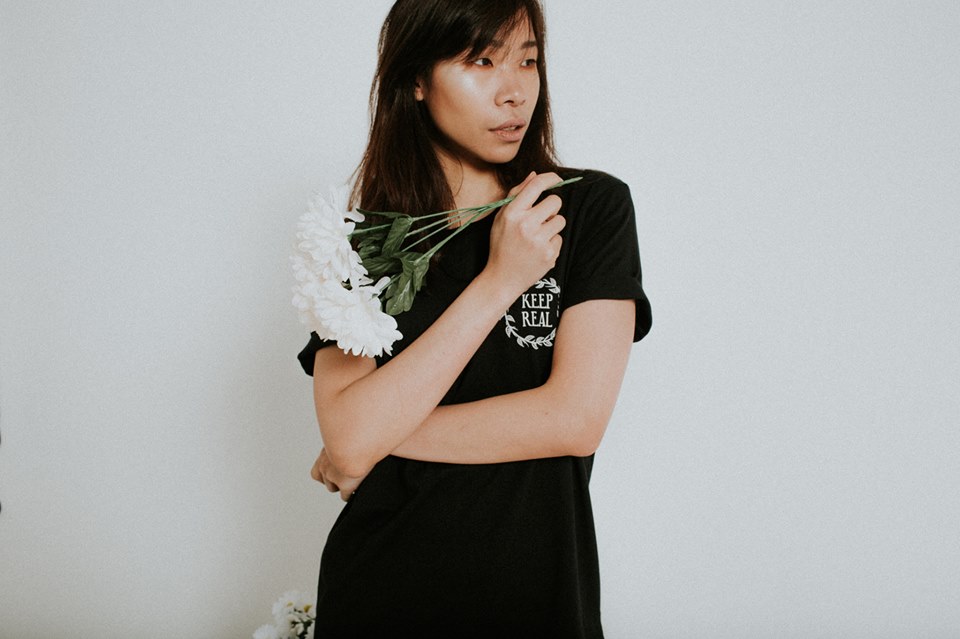
This black t-shirt from Keep Real is subtle and so it’s perfect if you’re not confident wearing your label just yet. The Keep Real range is full of inspiring products which quietly promote emotional well being.
The ethos of ‘keeping it real’ is something I wholly subscribe to, so I adore the idea of wearing their emblem on my chest as a reminder to be honest with myself. They aim to source ethically sound materials for their clothes as well as recyclable and biodegradable packaging.
Since then I’ve spent hours lusting over their t-shirts, pins and apparel whilst feeling uplifted by their overarching message; It’s OK to be a crybaby.
Heads Above The Waves is a not-for-profit organisation that raises awareness of depression and self-harm in young people. They promote positive, creative ways of dealing with the bad days.
This hoodie was inspired by Alan Watts who said “I have realised that the past and future are real illusions – that they exist in the present, which is what there is and all there is”.
Hoodies are essential garments for me. Although I’m all for reclaiming my mental illness with confidence, I still have those days where I want to be enveloped in comfort. This soft hoodie is exactly what I need on those days!
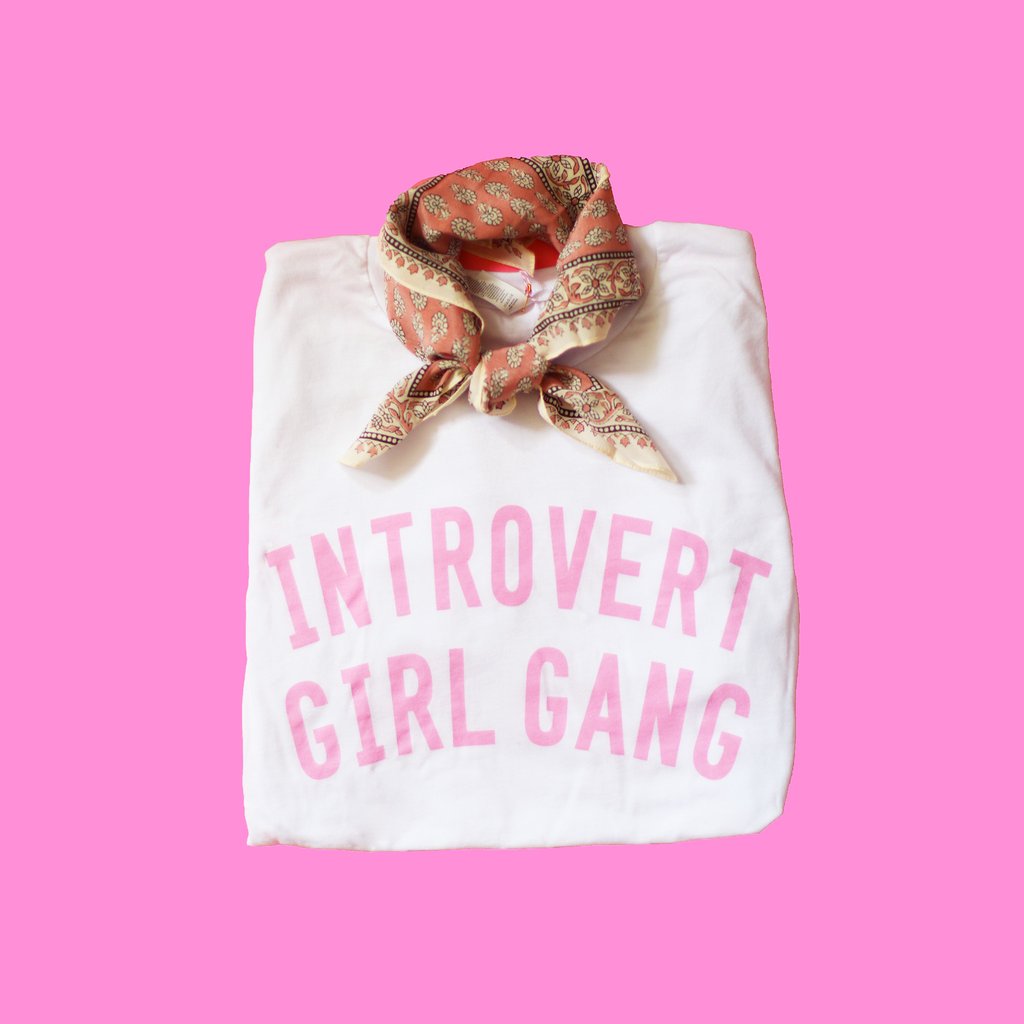
I’m always banging on about being an introvert, mainly because I only realised I was one less than a year ago. This Introvert Girl Gang t-shirt from Shop Luella number one on my wish list because I want everyone to know that I’m not rude, I’m just introverted!
Wear Your Label have been flying the flag for mental illness for a few years now. Started by two friends who had their own mental health struggles, you can really feel that the creators understand how difficult it is to talk about mental illness.
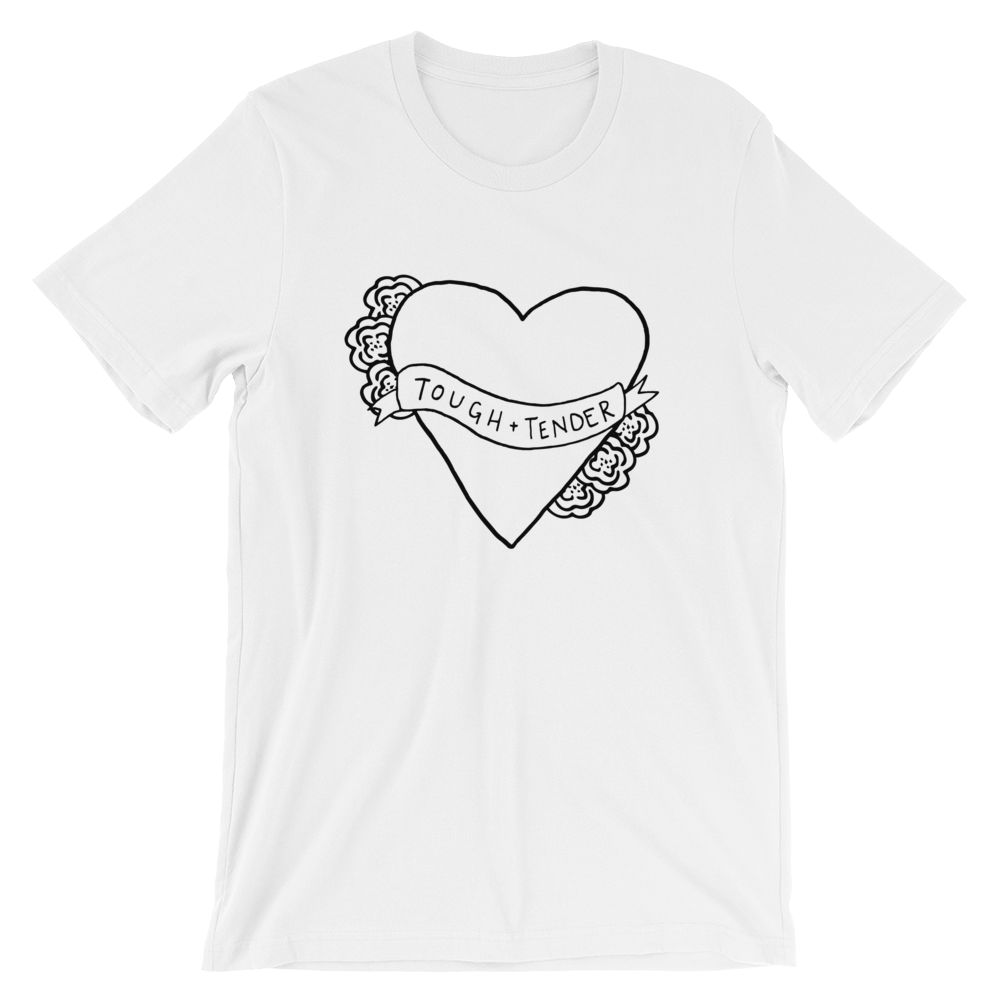
I talk about negative body image a lot, and I’m still a work in progress when it comes to loving the skin I’m in. Just because you’re not fully ‘there’ with your self-love doesn’t meant you can’t still be an activist on the subject though.
I believe sometimes you just have to fake it til you make it. I’m continually ignoring the negative voices in my head and trying to amplify the positive thoughts, so have this t-shirt on hand for the bad days is a plan I need to put into action.
Model Felicity Hayward has been kicking arse in front of the camera for several years now by being bold, beautiful and proud of her body. She’s embodied her ethos in a range of t-shirts plastered with the “self love brings beauty” slogan and quirky illustration.
I love the image of hands creating a heart, because it really drives home the idea that you are in control of your own self-image. It shouldn’t be dictated by the way others see you, or how certain body types are portrayed in the media.
As long as you can learn to treat yourself with care, you’ll feel beauty from within.
Mental illness merchandise
I’m not going to lie, looking at this inspiring lot has got me more than a little bit tempted to start working on my own mental health clothing to sell online. In fact, I might just make a batch for me to wear myself! Are there any areas of mental illness that you feel are particularly marginalised and need to be put in the spotlight?
My Scottish pals will be pleased to know that there’s a new outlet for t-shirt printing in Glasgow called Printsome who have kindly sponsored this post. They offer free shipping on all orders and will print anything from 10 to 10,000 items catered to your specific needs. They also have a blimmin’ good selection of t-shirts, hoodies, bags and hats.
How will you choose to wear your mental illness? I’d love to know in the comments below!
Depression is a tough subject. There’s no getting away from the fact that it’s a painful illness that affects many of us, but I want to take a moment to talk about recovery and how it can begin to happen without us realising. I didn’t think I would ever recover, but I did. To mark Mental Health Awareness Week 2017 here’s an account of how I went from just surviving to thriving.
The small things matter again
I can’t pinpoint exactly when this happened for me, but I remember vividly how difficult it was for me to see the point in doing a lot of things. Showering seemed pointless, as did cleaning, wearing nice clothes or taking pride in my home. I didn’t wear make up because I thought, “I just have to take it back off again” so I didn’t bother. This idea of having to do things repeatedly was something that really tore me up inside.
Getting a part-time job was a major factor in helping lift that feeling, because doing the same tasks everyday was essential to doing my work correctly. I started waitressing in a cafe where I’d previously worked as a teenager, so it didn’t take me long to remember how to do everything.
Cleaning down at the end of the night and making sure everything was stocked for the next day was just enough responsibility to make me feel like I could contribute something to society and be helpful to others. Once I saw the positive effect my effort had on other people I felt compelled to continue.
Hobbies are fun again
Although I maintained my passion for fitness during the worst stages of my mental illness, other pastimes didn’t appeal to me any longer. I didn’t enjoy shopping or going out with friends. I used to love going to the cinema but I often found myself unable to concentrate during a movie or would fall asleep half way through.
When I started to take an interest in blogging again, I knew I had won back some of the enthusiasm for life that had been absent for so long. In the past ten months I’ve worked on my blog almost everyday without fail. I still get tired and frustrated with all the hard work but I really enjoy it overall. I get so much satisfaction from being creative and talking about mental illness online that I can’t see myself ever giving it up.
I can spot my obsessive behaviours
Writing about my mental illness means I’ve become even more self-reflective than before. As a result I’ve been able to better judge my behaviour and spot when I’ve been acting irrationally. I used to make family and friends change their plans to make sure I could still go to my scheduled keep-fit classes. I would control which restaurant we went to to ensure I could eat a specific type of food for weight loss, and I would be very anxious if any of those plans changed at the last minute.
I quit dieting about a year ago and since then my whole outlook has changed. I have the freedom to eat what I want and it’s made me feel a lot more laid back about things in general. Now I can see that I was really just using that as a form of control and I’m trying to work in improving that.
I can support others
Having depression makes it extremely hard to be sympathetic to others. I couldn’t talk to other people with depression because I was unable to say any kind words. I felt like I was the only one who felt this bad, and that no one – not even someone with the same illness – would understand.
I spent many months relying on my husband and family to assist me with everything. I needed help getting ready, going to appointments and making basic decisions, so how could I hold my own in a conversation with someone just as vulnerable as me? It wasn’t until I was working with a young girl who had depression that I realised I was strong enough to reach out and offer support to someone else.
Somehow, I’d come far enough to be able to lend a helping hand and acknowledge that someone else was in distress. I don’t know how much I really helped her in the grand scheme of things, but I was always kind and tried to listen to her issues and offer as much advice as possible from my own experience. I didn’t realise I was better until I could actually tell someone else with confidence that they would get better too.
I can ignore negative thoughts
Recently I’ve realised that I’m now able to acknowledge my mental illness and let the symptoms play out without letting them affect me too much. I know the things that make me anxious; busy places, being around drunk people, meeting new people and long journeys on public transport. I’ve figured out that I can still put myself in those situations and not crumble, and it feels amazing!
I plan ahead as much as possible and distract myself when negative feelings arise. I avoid caffeine because it makes my anxiety worse. If I do these three things then I know I can ride out the storm and come out the other end unscathed.
“She isn’t depressed. She goes to work everyday and I see her out at the weekend”
This is the kind of thing I hear muttered again and again about people with mental health issues. Everyone says they are more ‘aware’ of mental health problems, but when push comes to shove they don’t always want to accommodate people who have real issues. Worse than that, I’ve actually heard the above phrase said by someone who has suffered from depression themselves. I find it strange that a person cannot empathise with someone else who has the same condition, but displays different symptoms. Sure, there are some symptoms that are common in everyone but others that are completely absent.
The truth is that every mental health sufferer looks and acts differently.
When I was trying to define my own mental health problems I remember my GP explaining to me that sadness is a normal human emotion, and obviously something that we all have to deal with in life. Some people will feel ‘depressed’ and although it may feel very intense, it will last a relatively short period of time and the mind can recover from the situation naturally. Other times it will be so intense that the person cannot recover alone, and will require medical attention. He made me realise that my own depression was serious, prolonged and could definitely benefit from medication to help rebalance my brain chemicals.
Identifying depression in people can be incredibly hard. So many people appear to have it ‘together’ when really underneath they’re seriously ill. I didn’t realise this until I lived with depression myself for the past four years. A few weeks after I had been diagnosed with depression I was due to go on holiday to Spain. I decided to go, as I was aware vitamin D could help lift my mood slightly, and lots of people had told me maybe a holiday was ‘just what I needed’.
The picture above, along with many others, was taken whilst we were on holiday for a week. I look pretty pleased with myself! I remember the night before this was taken I had drank too much and had a total breakdown in front of my now husband on the roof of the apartment we were staying in. I confessed how deep my negative feelings were and how I felt I would never get my life back again. My sunglasses helped conceal my puffy eyes from crying all night and having had very little sleep. I managed to drag myself out of the flat late in the afternoon to take a walk down to the beach, and I was pleased I hadn’t completely ruined the day by being a recluse which is what my instinct told me to do. It’s easy to see how people may have thought I was out having the time of my life whilst I was off sick instead of being at work, when really I was battling with a serious mental health problem.
Below is a picture of me approximately a year into my depression. I was at a friend’s birthday celebration in a venue I’d never been to, with people I’d never met. I look pretty happy right? I’ve got a cute dress on and my hair looks good, but inside I was terrified. To anyone scrolling through my Facebook feed, I’m sure it would seem like I had it all ‘together’ and certainly had no reason to take two different types of medication, see a therapist weekly and claim benefits for being unable to work. If I can go for a night out on the town surely I can get a job, right?
Well, no. This evening took weeks of preparation. I planned meticulously how I would get to and from the restaurant which required my dad driving the 40 minute journey there and back. I made sure in advance that the people I already knew would sit directly next to me and not let anyone else probe me for too long, as conversation made me anxious. I chose from the menu ahead of time because I had issues with food, and I was going through a particularly bad phase where I was restricting lots of food groups from my diet. All in all I think I was there for about two hours before I went home, mentally exhausted from the build up and execution of the whole situation. Doing things like this normally meant I was out of action for a few days after to recharge my batteries.
If you’re still struggling to see things from my point of view, this article on people with high-functioning depression explains how sufferers feel and what they wish other people could understand. Just because someone is at work doesn’t mean their feelings of depression aren’t valid. For many people a rest would actually do them good, but they feel unable to take time off because of their busy workload or they’re worried they’ll have no purpose without a job to go to. For some people work is the only distraction that helps them get through the day.
Often, going out with friends is deemed as evidence that someone ‘faking’ depression. Just because someone is smiling and having a few drinks doesn’t mean they’re not mentally ill. A key part of recovery is maintaining good relationships and being sociable now and again, the rare times that we feel up to it. If we make people feel guilty about being seen out in pubic, we encourage anti-social behaviour where vulnerable people will cut off that important contact with the outside world, which can worsen their condition.
I think a key part in improving this difficult situation is to open up the discussion with those close to you. Instead of snooping on someone’s Facebook, or judging their social calendar; why not just talk to them? Ask that person how they’re feeling, what they’re doing and how their recovery is going. Why not get an accurate insight into what’s really going on instead of assuming you know it all from a brief snapshot on the internet?
I told some of my friends that I had depression as soon as I got diagnosed. The reason being; I knew I couldn’t hide it from them any more. My mood was unpredictable, my actions out of character and I was unfit for work. As far as my Facebook friends were concerned however, I was fine and dandy! I didn’t want to tell the whole world about my problems back then, but I knew my best mates had to be kept in the loop. It was hard. I felt embarrassed. Like I’d failed as a human and that I was somehow now using an illness as an excuse for not being able to cope with life. I know now that my inability to cope was merely a horrible symptom, and admitting I needed support was my first step on a long and winding road to getting my happiness back again. From my own personal experience, here’s my advice….
Be prepared for varied responses
A lot of people think that their inner turmoil is clearly visible to people on the outside. The telltale sighs of depression like being reclusive, feeling agitated, loss of appetite and inability to concentrate may feel acute and painfully obvious to you but don’t be surprised if none of your friends have been concerned about your well being.
It’s not that they don’t care, but simply that your symptoms haven’t been brought to their attention. They may think you’ve seemed different, but we all go through bad spells that aren’t necessarily linked to mental health concerns. So be prepared for your friends to be kind of surprised that you have some problems of that nature.
On the other hand, some friends might be overbearing; they might ask really in-depth questions about your health, thoughts, feelings, medical advice and medication. Some friends want to help ‘cure’ you and will offer you advice that might seem patronising, such as “maybe you just need to let your hair down” and “you should go on holiday”.
Try and be appreciative. I know it’s hard. Even if they don’t understand fully what you’re going though it’s good that they want to help. They might find this post helpful.
Give them time to process what you’re saying
If your friends have never dealt with someone who has been diagnosed with depression then they might be really uncomfortable when you start talking about your problems. Try not to be offended if they seem standoffish or act like it’s not a big deal. You know it’s a big deal and you’re trying to get better so that’s all that matters.
Give them time to listen to what you have to say. Let them go home and talk to their partner or family about the subject (they don’t necessarily have to mention your name) so that they can make sense of what you’re going through and consider their own actions.
Being friends with someone with mental health issues can be kind of scary. They might not know what to say or how to act around you because they are worried about upsetting you or making your condition worse. This is nothing to feel guilty about, just believe that if they are a real friend they’ll do what they can to help comfort you.
Think of one way they can help you
Before you bring up the subject have a think to yourself about what you want from them. Their instinct will likely be to utter that dreaded phrase, “Let me know if there is anything I can do”. I mean seriously, has anyone ever responded to that comment by actually asking for help? It’s one of those awkward “I want to help” moments where no one quite knows what to say.
As you know, depression feels like a tonne of bricks has been laid to rest on top of you, so small tasks might pile up whilst you take time to recover. Try and pinpoint a few things that are looming over you and ask if they would mind helping out.
I remember my mum offered to help me clean my house and I was really offended, when really my life would have been a little more comfortable had I just let her help. Looking back, I’m certain it would have given her some purpose too during a difficult period in our relationship.
Explain that you might act differently
This can be really hard, because maybe you’ve just been diagnosed in which case your symptoms will likely become different over the coming months. You don’t need to go into the specifics about how you’re feeling, but it would be good to explain the things your are finding particularly difficult. It might be shopping for groceries, driving to a doctors appointment or dealing with some unpaid bills. My problem for a long time was being out with big groups of people who weren’t my very close friends and family.
I became very reclusive and lost all self-confidence so social gatherings were my number one fear. Over time I managed to express this to my friends and they still accommodate me to this day. If I don’t want to go clubbing, drinking or into a crowded venue they don’t expect me to. They know drinking alcohol makes my condition worse so they don’t pressure me to have a drink when they are having one.
Knowing that these things weren’t expected of me took a huge weight off my shoulders, and when I was at my worst all of my best friends made an effort to see me in an environment where I was at ease.
Have these tips given you the confidence to talk openly to your friends about depression?
Privacy & Cookies: This site uses cookies. By continuing to use this website, you agree to their use. To find out more, including how to control cookies, see here: Cookie Policy