Select Page
5 things you shouldn’t feel guilty about when you’re depressed

5 things you shouldn’t feel guilty about when you’re depressed

Depression and guilt go hand in hand for many people. Let’s get one thing straight; you’re not to blame for your mental illness! Just like you wouldn’t be to blame if you contracted pneumonia or developed arthritis. The mind and body are open to injury and it’s nothing to feel guilty about, but I know from experience it’s not that easy. Here are some things you definitely need to think about…

Receiving gifts

I was thinking recently about how painful it was for me to receive birthday and Christmas gifts just after I was diagnosed with depression. Being unable to work meant I couldn’t really afford to buy for others, and I felt like I hadn’t earned the right to be given gifts or celebrate at all. My friends and family wanted to do anything to make me feel better, and giving me presents was their way of showing that. I know it’s really hard but try and accept any gifts you are given and see it as a symbol of support from those who care. If you’re someone who is struggling to buy gifts for someone check out my recent gift guide.

Taking time off

One of the main reasons I took almost 4 years to recover from mental health problems is that I struggled on at work for months without taking any time off. I didn’t realise just how serious my condition was – or that it existed at all – and so I continued to put myself under immense stress during a time when I should have been resting and allowing my mind to recover. It wasn’t until I finally did get signed off work that I realised how bad my symptoms were and that I would need months to recover. It’s natural to feel incredibly guilty about this but unfortunately it’s the only way for many people to recover.

Being seen ‘out’ when you’re unable to work

I was talking to a friend recently who has been signed off work with anxiety, and she was expressing concern about visiting the hairdresser whilst on sick leave. Essentially she was worried that she didn’t have the right to be out doing things in case it got back to her employers. Remember this; the reason you’re off sick is because you are unable to work. This doesn’t necessarily mean that you’re unable to get on a bus, go to the supermarket or go to the hairdressers. For me, work was actually contributing to my illness so it was essential that I stop doing it immediately. Going to the gym on the other hand, was easing some of the symptoms, lifted my mood and helped me get to sleep at night. Going out and doing the things you’re comfortable with is so extremely important to your recovery and should not be avoided for fear of ‘being spotted’.

Forgetting important dates

Did you know that depression is linked to short term memory loss? Don’t feel bad if you forget that you made plans with someone yesterday or you can’t remember what time your doctors appointment is. Before I was diagnosed with depression I was finding it really hard to remember what I’d done from one day to the next, especially at work. I ended up relying on a stupid amount of ‘to-do’ lists which were synced up to my calender and my phone and it all got very overwhelming. It’s totally normal to forget things and it doesn’t make you a bad person.

Eating convenience foods

Whilst living on Pringles and Pop Tarts isn’t the best advice I can offer you, there’s certainly a bit of wiggle room when it comes to eating the perfect diet when you suffer from depression. If like me, you’ve struggled mentally with dieting for most of your life then the will power to resist eating processed foods whilst fighting a depressive episode will be non-existent. There is a lot of great information out there on what foods are helpful in terms of brain chemicals and blood sugars, but don’t put too much pressure on yourself to eat well all of the time. That just comes with a whole other bag of problems that you don’t need, so eat as often as you need to satisfy your hunger and try to incorporate fresh fruit, vegetables, whole grains and healthy fats as much as possible.

Not convinced? Check out this helpful post I found called 5 ways to overcome guilt in depression. 

Thoughtful gifts for people with anxiety 

Thoughtful gifts for people with anxiety 

Anxiety sucks

The unwanted symptoms that accompany anxiety are feelings of depression, worthlessness and inability to function. When asked what I want for Christmas or my birthday I often say ‘nothing’, because I feel like I don’t deserve any presents. It’s not a cry for attention or a way to get sympathy.

Anxiety messes with your confidence and your self-esteem and makes you feel like no one cares about you and that they’re right to do so. It’s a constant struggle to feel like a ‘real’ human, and I often feel segregated and disjointed from the rest of society especially when it comes to birthday or Christmas celebrations.

Thoughtful gifts


If you’re looking for a gift for someone with anxiety, I totally understand why you feel at a loss as what to buy them. When you hand over that lovely little package, I want you to be confident that you’ve chosen something that could potentially make their lives easier or at least offer some comfort at a difficult time.


None of these gifts are going to be a quick fix for mental health problems but they can act as a subtle reminder that your support is always available. You might even want to direct them to this blog for a little friendly reminder that they’re not alone

You Got This

If you’re looking for something to boost your mood, I’ve created this beautiful mini magazine A Feel-Good Zine which is filled with original writings on mental health as well as artwork by Chloe from The Feels Club.

It’s not designed to cure the symptoms of depression and anxiety, but merely act as a companion for when you’re having a bad day. You can buy it via my shop here.

you got this zine mental health gift

Buddy Box


Subscription boxes are still going strong, and this Buddy Box from Blurt is a well thought out addition to the selection with a focus on mental health. Although they specialise in boxes for depression sufferers, you might find that your friend could still benefit from a box of treats tailored to mental well-being in general. You can purchase a one off box or sign up for monthly deliveries with a different set of gifts delivered throughout the year. Check out this review from Hannah for an example of what comes in each box.


Positive pins


Pins and patches are the currency of the modern mental health sufferer. This pin duo from Diglot Etc is incredibly cute and this one from Blurt can act as a reminder that you’ve got someone’s back.


what to buy someone with anxiety


Spinning Rings


I find when I’m anxious I tend to fidget a lot – I bite my nails, constantly fix my hair and readjust my clothing. I also habitually play with the rings on my finger; twisting them around and taking them off just to put them straight back on again. I didn’t realise this was so common until I spotted these Spinning Rings on Etsy. Not only are they helpful to those with anxious habits like me, but they are absolutely beautiful in their own right.


what to buy someone with anxiety


Self-care gifts


I know that ‘self-care’ is really popular at the moment, and to be honest I think that can only be a good thing. Yes, it’s a tad cheesy to talk about taking care of oneself but it’s something that so many of us let fall by the wayside. I can’t afford to spend a lot of money on skincare and make up and if someone gifts me some luxury bath products I really appreciate it. It also encourages me to take more time to relax, have a bath and give myself a treat or two.


Pretty much every girl I know would be grateful for a gift box from Lush  and this one is particularly good for winding down as it features a lavender scented shower gel and several soothing bath products. To really secure a good night’s sleep why not add in this Great day, good night duo from This Works?


what to buy someone with anxiety


Mindfulness gifts


I know from personal experience that it can be really frustrating when people suggest various ‘cures’ for your anxiety. Yes, I’ve tried yoga and getting more exercise and there’s no need to patronise me! If you want to offer a suggestion to someone you know who as anxiety then Christmas could be the perfect opportunity.


Although I’ve never tried colouring for mindfulness this Alice in Wonderland colouring book could tempt me to give it a go. I also love The Mindfulness Companion book which has sections for writing down your current mood, feeling and has colouring pages included too.


If you’re affected by anxiety would you like to receive any of these gifts?

READ NEXT: Gift ideas for friends with depression


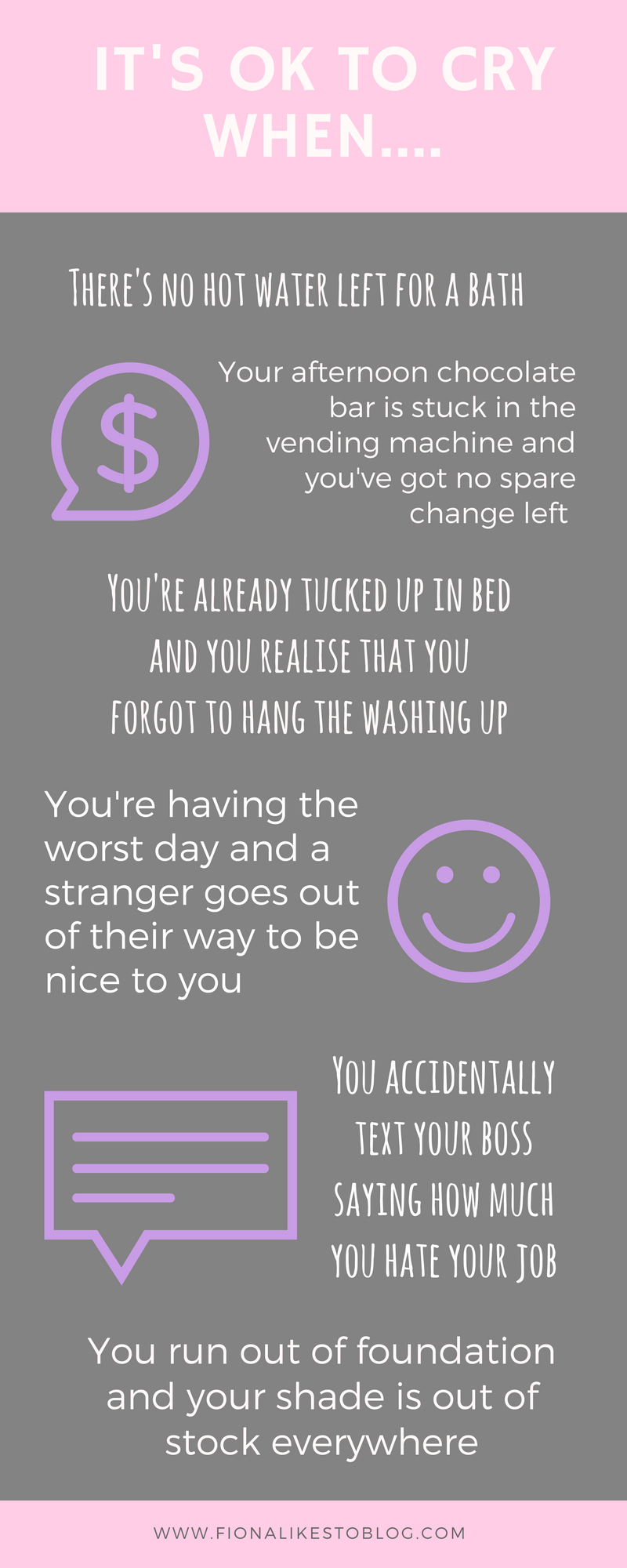
Why it’s absolutely OK to cry about stupid stuff

Why it’s absolutely OK to cry about stupid stuff

I’m a crier.

I like a good sob, normally in private and more than likely about things that are really not important.

I’ve been known to weep uncontrollably when I’ve fucked up my make up, when the bag splits on the way home from the shops and when my parents’ dog ate £100 straight out of my handbag. I know you probably think I made that last one up but I can assure you I really didn’t.

The thing with me is that I tend to sit on my emotions. I’ll let thoughts get trapped in my head, they wear away at me and grind me down for days or weeks until they finally surface in the most unexpected manner. I regularly find myself in the ‘straw that broke the camel’s back’ scenario, whereby it only takes something small and seemingly meaningless to send me into a fit of rage followed by the waterworks explosion. I can cry that sickening way, when you feel like you might hurl because you have so much sadness bubbling over and you just have to get it out.

its OK to cry about things that aren't important mental health

The great news is that I normally feel better after a good old strop and a tear-fest. No matter what has pushed me to boiling point, my mind is clearly in need of some sort of release – so it finds its own way of getting it. It sounds like I’m a dramatic person (OK maybe I am at times) but I only have these little tantrums because I’ve remained so calm and collected on the surface for so long. I have been in that situation long term and it seriously isn’t good for your health. I’m trying to work on keeping my mind relaxed and de-cluttered but it’s a work in progress.

My advice is to cry when you need you. Even when it seems unreasonable, even when you can’t explain what you’re upset about; cry away and you’ll feel so much better in the long run.


How to make friends when you have social anxiety 

How to make friends when you have social anxiety 

I had two bad days this week. Sweaty palms, a huge knot in my stomach and shortness of breath were just a few of the symptoms that followed me around whilst I tried to appear normal to the rest of the world. I try not to bother people with my anxiety when it crops up; firstly because there’s not much anyone can say to make it go away and secondly because I don’t like drawing attention to myself. I guess I should work on that.

I did overcome one fear this week though; I went to my first blogging event on a day where my anxiety was really bad. Seems impossible right? It was all down to making some new friends, something I never thought I would be able to do since I started suffering from anxiety and panic attacks a few years ago. Here’s how I did it…

Make a few close friends

The biggest thing that helped me get through those few hours of socialising with strangers was already knowing a few people attending. It meant I didn’t have to turn up on my own or find anyone to talk to! If you’d asked me six months ago what I was most looking forward to about moving to Birmingham the last thing on my list would have been making new friends.

For me, going out and meeting new people is like asking someone with a fear of spiders to go on “I’m a Celebrity” and eat bugs in return for their dinner. I would rather just go hungry. It’s something I’ve feared so greatly for over four years now, that I can’t quite believe I’ve built my own little circle of friends all on my own. I only have a handful of friends but I personally think that’s better because I can explain my mental health problems better in a small group, which is means everyone is aware of when I’m not feeling 100%.

Use social media

I didn’t have a clue how to even start meeting new people, and to be honest it wasn’t something I was planning on doing straight away. My main focus when I moved to the city was to find a job and work on my blog. I found a job within two weeks and started building my Twitter followers to get more blog traffic. Whilst I had some extra time on my hands I followed every Birmingham Twitter group I could find (Brum Bloggers, Brum Hour, etc) and got talking to other followers.

I noticed a few other bloggers tweeting things like “I’ve just moved to Birmingham and I don’t know anyone” and felt compelled to speak to them, even though it made me really nervous. Leaving the comfort of Scotland where my friends and family were always on call meant for the first time in my life my loneliness outweighed my anxiety, so I reached out to a few girls in a similar position.

My advice to anyone looking to make friends on Twitter would be to make as many connections online as possible, and don’t think about the actual real life meeting until it happens. I talk to lots of people online that I’ll probably never meet in person, so I just enjoy the conversation for what it is; a brief meeting of minds over a funny GIF or a relatable comment. Over time you’ll strengthen some friendships and these are the people you should meet in real life. The girls I met on Twitter actually talk more to each other via text than we do online, I think that’s a good thing because it feels more genuine.

Be honest

This one is hard, because it can be really scary to tell people you’ve just met that you have mental health problems. I urge you to mention to at least one of your new acquaintances that you have some anxiety issues, so that they understand if you flake out last minute or don’t seem your usual self once in a while. In fact, social media is perfect for this because you can tell them about it – in as much or as little detail as you desire – via direct message instead of actually having to go through the horror or mumbling the words out loud. Go on, be brave. It’s so worth it.

Have you struggled to meet new friends because of social anxiety?

Why I had to lose my career to save my mental health

Why I had to lose my career to save my mental health

“Do you want a sick line?” the doctor asked me, and as she did so I breathed a sigh of relief.

I had been considering speaking to a doctor for weeks at this point; repeatedly lifting the phone to my ear, dialling the number and then slamming it down in protest, adamant that I’d be laughed out of the doctor’s office and told to stop being so dramatic.

I can’t remember exactly what tipped me over the edge and forced me to make the appointment, as a lot of it went by in a blur. I vaguely remember hiding in toilets at work, losing my temper with a team member over something incredibly insignificant and crying uncontrollably on the bus home every night.

Not exactly the behaviour you’d expect from a manager who is overseeing 4 supervisors, 20 team members and running several retail outlets and 2 departments simultaneously.

I knew I was stressed. My workload had increased dramatically over the 6 months leading up to this and I was feeling troubled following the death of a grandparent. I knew I wasn’t coping very well. I remember looking at my ‘to-do’ list and thinking that it was too overwhelming.

My brain couldn’t process the list into actions, and it was like I was trying to read hieroglyphics. There seemed like no good place to start. I didn’t want to start. I needed a break, but asking for it felt like a sign of weakness. I’d always got promoted on the basis of saying yes to more work and more responsibility. For a proud career woman like me, saying I couldn’t handle it felt shameful.

When the doctor heard my symptoms she very kindly suggested I take a few weeks off to recuperate and prescribed be some beta blockers as she thought I was having some anxiety issues. Being given that ‘permission’ by an authority figure was just what I had been looking for. I felt reassured.

There was certainly no talk of depression.

I left that day happy in the knowledge that I just needed some time to relax, gather my thoughts and was certain I’d get back to my career in no time at all with the support of my boss to help ease the workload. Just a short break.

quit my job mental health


After a week, having given my mind and body the rest it had been silently screaming for I was suddenly overcome with the feeling of hopelessness. Darkness. The kind that feels like a dense, damp storm cloud enveloping your whole body to the point of suffocation.

From the doctor’s waiting room I stared out at the beautiful summer sky but all I could see was my desolate, pointless existence. Nothing mattered any more. The beta blockers were quickly swapped out for something new and a fresh sick line was scribbled, revealing the worst.

Patient is suffering from depression.

After 3 months off work I had exhausted the generous amount of sick pay allocated to me and I had to make a decision. I had tried going back to work a day here and there; the HR department were very accommodating and let me try a ‘phased return’ but doing my job seemed incomprehensible. How was I supposed to lead a team?

How could I adhere to health and safety standards, deliver award-winning customer service, and control a department budget when I could barely find the energy to take a shower everyday? How could I sit in meetings and listen to company objectives when in my head I was contemplating the very worst, every moment of every day? How could I performance manage staff when I couldn’t see the point in doing my own job?

I felt backed into a corner – not by my employer – but by my illness. My job required a certain level of attention that I physically was not capable of offering. So, I quit. I had spent 5 years in the industry; on my feet for 50+ hours a week, doing all the shitty jobs, late nights, early mornings, working for pennies, and finally I had landed the highest earning job of my career. I was in a desk job with sociable hours, stability and lifelong prospects. Then I lost it all. Through no fault of my own, all of a sudden had no ability to do the job I had worked so hard to secure. Even now – 4 years later – I feel totally incapable when it comes to the tasks I used to complete with ease. There is an entire skill set on my CV that I may as well just delete. I have the experience, but I believe I’ve lost the capacity.
I’m not trying to encourage people to quit their jobs as soon as they’re diagnosed with depression.  Not everyone will be affected the same way that I was. A lot of people find their job is the one constant in their lives during a depressive period, and it gives them comfort to focus on something other than their own mind. I just want to be completely honest about my experience and what I personally had to do to get better.

I feel angry that I had to lose my career to save my mental health. I feel like I had this enormous setback in life where all my hard work had been for nothing. This stupid illness came along and it took over my life. The honest truth is that it still does. I’m almost certain it’ll control me for the rest of my life. Is this the way it should be? Should we feel forced to be unemployed, unable to contribute to society because of our brain chemicals? Absolutely not, but it’s the situation many of us find ourselves in. Feeling overwhelmed? Take a look at my self-care tips for when you’re feeling depressed.

Today, I have no confidence in my ability as a manager. I’ve worked in middle management roles during my recovery (which is ongoing, by the way) and although I can do it, I seem to have a finite amount of energy for jobs involving leadership. It eventually takes its toll on me and I either have to quit, reduce my hours or hand over some responsibility to others. So unfortunately at the moment, I only feel capable of doing a job which as no responsibility and pays minimum wage. Some people would find this humiliating, and I did too at first. The alternative is to earn more money and compromise my future and I’m just not willing to go down that road again. Its simply not an option.

customer service mental health

There’s a certain freedom that comes with working in a less pressured work environment. My job no longer defines who I am, but that’s a good thing. I’ve learned that it’s OK not to have the career I thought I once deserved. What I actually deserve is a healthy, happy, fulfilled existence.

My career did give me that for a while, but I couldn’t continue. Now I’m on the road to discover what else I can do, what else I can create, experience and give to others in order to get some sort of satisfaction whilst maintaining a balanced head. Having a less stressful job has given me the energy to explore the creative talents that I always thought I would pursue after university, but never did.

Creating content for my blog is one thing that I really look forward to doing. This thing came to exist because of me. Does it pay the bills? No. But I’ve learned stimulating my brain is incredibly important to my own well being; so if waitressing everyday allows me the opportunity to share my thoughts on here the rest of the time, then I think their are worse things I could be doing, don’t you?