
by Fiona likes to blog | Aug 8, 2023 | WRITING
Wow we are truly moving into the end of 2023.
I’ve seen some major shifts in my life over the summer: I have my divorce paperwork all done and dusted, I finally moved out of my parents’ house and am renting a room in Glasgow. I own six plants! Will they survive the winter? Only time will tell.
Writing-wise, I’ve begun blogging again which has felt like an emotional release I didn’t know I needed. The thing about being self-employed is that a lot of the writing I do is either for a client, a publication, or rooted in marketing strategy in order to generate more sales.
But blogging, maaan, I forgot how much freedom I have on this platform to just say what I need to say. Write what is in my head at that exact moment, and publish it without needing to be positioned in a certain way, it’s so freeing for me personally and is also reminding me WHY I started writing in the first place.
If you’re new to these parts, you might not know that I started my writing career as a fitness blogger. After doing that for a year, I bit the bullet and started writing about my mental health.
Back in 2013, that was a scary prospect. I didn’t share my blog with friends and family for yearsssss because I was kind of embarrassed about being so vulnerable on the internet. But really, it was that vulnerability that taught me the therapeutic potential of writing, and it also led to my first book deal.
Anyway, I’m kinda feeling envigorated about writing which is perfect timing because I want to share 3 ways you can work with me on your writing over the next few months:
Perfect for you if you’re looking for a one-off, creative burst to reignite your writing journey. Together I’ll take the group through a mix of journaling, fiction and poetry exercises interspersed with creative conversations and pep talks.
You might meet a buddy who you can continue to write with online, you might create something you’re really proud of, or get a brand new idea that you’re excited to get stuck into. Either way, you’ll leave with your creative cup full to the brim.
£111 or payment plans from £37
My signature writing program Inspire Write Repeat is back for the final iteration of 2023! If you’re someone who struggles to make the habit of writing stick for any longer than a few days, this one is for you.
We log onto Zoom twice a week (although some people opt for just once!) and write together using fresh prompts or do a guided session where I teach you a new technique. This round also includes a free ticket to the retreat mentioned above, a 1:1 tarot reading and a chance to socialise with members.
£677 or payment plans from £67
For those of you who want my undivided attention, private mentoring offers me in your pocket for 3 months.
You’ll get 1:1 mentoring calls, goal-tracking spreadsheets and written feedback on your writing. If you’re ready to level up your writing, get in touch.
£1500 or payment plans from £500

by Fiona likes to blog | Aug 6, 2023 | LIFE, WRITING
I’m recently divorced after being in a relationship for almost 18 years, so it’s been a huge learning curve getting used to being on my own again. Whether you’re a student, a professional, working from home, living the single life or keen to romanticise your relationship, I think actively creating a life that gets you excited is possible for everyone.
At first, I thought romanticising your life was about travelling solo (which I did!) but then I realised that it can be about the little things too.
I don’t believe that romanticising your life is solely about grand gestures, expensive purchases or seizing every opportunity that comes your way. It’s about capitalising on what you have today, about being grateful for where you are now and taking pleasure in the things that bring you joy, no matter what anyone else thinks.
1. Reorganise your space
When I was a kid I loved the film Calamity Jane. My favourite part is the montage where Jane and her ‘friend’ set up in a tired little cottage and spruce it up into a home, whilst singing a song about a woman’s touch.
Although I’ve now realised that this is an iconic cinematic moment for many lesbians my age (little baby me had no idea) I think it’s a perfect example of how taking pride in your space can be a beautiful act of self-care.
It’s also an invitation to slow down, to think about how your environment not only impacts your mood but how little tweaks can turn your home into a sanctuary.
How can you create the feeling that you want to embody by using all the senses?
This could be:
- spending an afternoon quietly cleaning the windows
- dusting and rearranging your favourite trinkets
- picking out your favourite tarot cards to display on the mantel
- shopping for second-hand artwork
I like to light incense to signify a peaceful stage in the day, and music to get me into the right mood.
Imagine your favourite restaurants, cafes or hotels you’ve been to. What about that space felt comforting to you? It’s easier than you think to create that vibe in your own space, especially with sites like Vinted where you can pick up second-hand items on a budget.
2. Make mindful rituals
I’ve always been a coffee lover, but my mornings have gotten better since I started using coffee grounds instead of instant.
Something about the art of getting my Aeropress or French press set up, scooping the coffee just so (I love Fower coffee) boiling the kettle and waiting for it to filter through makes the whole process way more romantic.
Instead of mindlessly stirring instant coffee in 30 seconds, this process takes around 5-6 minutes and requires me to step away from work and ground myself in the present moment, using the act of coffee making as a reason to pause and be patient.
Other mindful rituals I enjoy include:
- meditating
- doing the dishes slowly by hand
- experimenting with new make-up
- applying a face mask
- shaving my legs
Any task that you do regularly has the potential to be turned into a romantic ritual, the trick is to be fully present in the ritual and focus only on the task at hand.
3. Dress for yourself
I think we’re all guilty of saving our best clothes for a future date and working from home means that there is always the temptation to wear grotty PJs all day every day.
Take the time to put together an outfit that expresses who you are and how you want to feel that day.
Maybe that means PJS, but the clean, fancy ones you normally reserve for the weekend. Or maybe it’s taking the time to change your earrings, wearing perfume and painting your nails on a Wednesday evening.
Taking pride in your appearance, even when no one else is around, can be an empowering experience and one that makes you realise your life is yours to be created on a moment-by-moment basis.
4. Write in public
I’m actually writing this blog post from a cafe near my house. There’s something soooooo main character energy about writing in public that I will never tire of.
Maybe it’s because I love people knowing that I’m a writer, or because being witnessed makes it a sort of performance that I enjoy, or maybe it’s the hubbub of people coming and going that makes me feel part of a ‘scene’ that I wouldn’t be part of at home.
Either way, I highly recommend taking your notebook or laptop out to a quirky little cafe, ordering a coffee and cake and writing your little heart out, pretending you’re a character in a movie. If you want to journal, check out my free daily journaling guide here.
5. Create the soundtrack to your life
On a workday, I like soundscape music such as coffee shop sounds, and in the evening I like reiki healing sounds. On a weekend I delve into my pop playlist and romantic indie songs to evoke a sense of self-love.
Whenever I hear a song that makes me feel really happy, I add it to a playlist for when I need to boost my mood. There are particular songs that I enjoy listening to as I walk, because that’s when I feel my most upbeat and as though I’m in control of my life.
My favourite walking songs are:
OK, that’s my thoughts on how to romanticise your life. How are you feeling about trying some of these tips? Do you have any other unusual ways to share with me? Leave them in the comments below!

by Fiona likes to blog | Jan 10, 2023 | WRITING
Looking through photographs of myself through the years has always been fun. Bad haircuts. Embarrassing outfits. Teenage romances. You know the drill.
But last year, I found looking at those same images difficult. Who was I? Why didn’t I allow myself to unfurl naturally instead of pretending to be someone else to fit it?
Photographs of my married life were particularly triggering, because since coming out as a lesbian in January 2022, the woman who appears in those images isn’t just alien to me, she’s someone I’d come to detest.
Anger plays a role in everyone’s life, but I don’t think it’s uncommon for the majority of that anger to be directed at yourself. We all have regrets, but how do you let them go? How do you acknowledge that you did the best you could at the time, and so your past self-compassion for all that she’s been through?
These are the questions that came to a head last year as I went through the process of editing and rewriting my first book (Work it Out: Finding Connection in the Digital Age without Falling Apart) and although I haven’t fully let the anger towards my younger self go, I’m getting closer to that place. Therapeutic writing (and building a regular writing habit) has helped immensely, and my aim isn’t to shut out the past versions of me but to integrate them into my current self, to let their multitudes exist in my head and come and go as they need to.
What is therapeutic writing?
Different from psychotherapy, this is a form of writing that has therapeutic benefits. In the same way that yoga can relax your mind or painting on a canvas can express difficult emotions, therapeutic writing serves as a way to improve your well-being without (or supplementary to) expert medical support. It is not a substitute for mental health support, and I am by no means a therapist, but I have been writing for well-being for a decade and recently completed a 6-week course on the topic.

Here are a few of the writing techniques that have helped me recently.
1. Stepping stones
In the same way that you use stepping stones to cross a stream, it can be helpful to bullet point moments in your life that have brought you to where you are today. This technique can be used to frame your whole life or a shorter period of time such as a year or a decade.
Decide on the time frame you want to cover and write down 10-12 stepping-stone moments that have played a pivotal role in that period. Don’t allow self-doubt to creep in and don’t write anything more that a few words for each bullet point. The trick here is to write quickly to tap into your subconscious so don’t second guess anything that you’re writing, just get it on the page. It should only take a few minutes.
Now go back to the list and expand on 2-3 of the stepping stones by writing a paragraph about the person you were at that time.
- What struggles were you facing?
- What habits (good or bad) were you practising?
- How did you present yourself to the world?
- What was going on in your work and personal life?
- How was your physical and mental health?
Take a break and come back to what you’ve written. Reflect on whether there is any link between these snapshots if there are any recurring themes, and what you would like to say to that version of you now that they have lived through it. What would you say to that person if they were a close friend? Would you praise them for their resilience? Ask them if they are OK? Show as much compassion as you can at this point, but be honest if there are still feelings of resentment. Releasing all feelings on the page is better than keeping them locked inside.
Over time, feel free to go back to each stepping stone and repeat the exercise. To broaden your scope of what you have lived through and how each version of you has been an essential part of getting you to where you are today.
2. Shift perspectives
Looking back on things you’ve done is all well and good, but we forget that the person we are today has so much more wisdom that the younger versions of ourselves. Think of a version of you that you are struggling to align with. It might be the past self who drank too much and made bad decisions or the past self who spent her money on handbags instead of saving for a house deposit, or anything else that makes you feel sad, angry or regretful. Now set a timer for 10 minutes and write freely about that time in your life, from their perspective at that time.
So for example, I often think about how my teenage self kissed girls and brushed it off as ‘experimenting’ in her head. My journal entry for this exercise starts something like this:
I am 16, it’s 2002 and I don’t know a single lesbian in real life. Lesbian is a slur used to make fun of other people. Yeah, I like kissing girls but I know that having a boyfriend is what I’m supposed to have (that’s what all the love songs and TV shows tell me) so obviously that’s what I want. I feel sad and disconnected from the world and I assume that being open about how I feel about girls would only make that worse. I’d rather have a boyfriend and fit in. I feel unattractive and boys don’t pay me much attention, which makes me feel like an outcast.
You’ll be surprised at how quickly you can get into the mindset of your past self and remember all the environmental, physical and social factors that contributed to the decisions they made at the time. It’s humbling actually, to step into their shoes and remember how hard things have been and how much you’ve experienced.
3. Gratitude list
Gratitude journaling is the perfect way to round off doing one or both of these exercises, especially because they can feel mentally taxing and dredge up some painful topics. Pick a past version of yourself or an experience that you’ve lived through and write at least 10 things that you’re grateful for in relation to them.
For example, my gratitude list for my teenage repressed lesbian self is:
- I’m grateful that you had even just a few positive experiences with women at that age
- I’m grateful you wanted to keep yourself safe and therefore didn’t open up about it.
- I’m grateful you chose to be sociable and fun even when you felt you didn’t fit in.
- I’m grateful you chose to save some friendships instead of making them complicated.
…. and so on.
To finish your journaling session, close your eyes and take a few deep breaths. Imagine you’re outside under a sky full of stars, sitting around a roaring campfire with a group of women who are all celebrating, laughing and joking together. Some of them are hugging or holding hands. When you look closer, you see that these are all past versions of yourself and they are welcoming you in. Do this visualisation regularly to integrate the past version of yourself with love and peace.
Buy Work it Out here.
![A Guide to Self-Publishing Your Book [Guest post]](https://fionalikestoblog.com/wp-content/uploads/2022/04/darius-bashar-vzfHHasUPk0-unsplash-1080x675.jpg)
by Fiona likes to blog | Apr 7, 2022 | WRITING
Guest blog post by R L Hanslow
I became a self-published children’s writer in December 2020, it was the year that changed everything for most people and I was no exception.
It allowed me to throw caution to the wind and just do it. Big girl panties were well and truly on.
If you’re reading this you’re either an avid reader of Fiona’s blog, one of my friends or family members (hi guys!) or you want to know how you too, can become a self-published writer.
Self-Publishing Tips
You’ve got the idea, you may even have a full manuscript and you’re at the, “What the H E double hockey sticks do I do now? “stage. Firstly, take a deep breath. Inhale for four, exhale for six, and we’ll get through this together.
My first self-publishing tip is this: Be realistic and define your version of success.
There’s a good chance you’ve got something incredible in your midst but traditional “success” won’t come overnight. It’s a gruelling path but one that can be rewarding in more ways than just making money. If money is your main goal it’s probably best to re-think your career choice or add side hustles.
The Basics of Self–Publishing
These are the three most common ways to self-publishing your book:
- Self-publishing completely by yourself. With this option you can of course hire the freelance assistance you may need but you cover working with retailers and distributors to sell your book. You can also be your own distributor.
- Self-publish by paying a service company to assist you.
- Work with a hybrid publisher.
I chose to go down option one for my personal circumstances, so the knowledge I have has come from trial and error in this process.
I submitted to publishers and I, amazingly, got positive feedback each time but as I’m classed as an ‘unknown author’ they won’t take the chance of giving a traditional contract (Where the publisher pays you for your book) and only offered me hybrid contracts (where they ask you to pay anything from £2,000-£10,000 to publish your book with them and they can make any changes they want).
I was told by author Alison Belsham that you should never accept a contract where you have to pay money to a publisher and I’m so glad of that advice.

Print On Demand vs Offset Printing
The next steps would be to tackle 3 key factors. These factors will help you to see which avenue is best for you and whether it would be best to do print on demand (POD) or traditional offset printing. Ask yourself the following questions:
- How/where do you plan to sell your work?
- Where do you want to drive sales?
- What is your budget?
I personally use Amazon KDP which is a free way to publish your book on Amazon on e-book, paperback and hardback form and the only charge is a percentage taken off any sale you get.
You get any royalties owed to you automatically every three months. This is a great option overall, but especially if, like myself, you don’t have a large budget to play with.
Side note: If you’ve got a book with a lot of illustrations or are catering to children, I wouldn’t recommend e-book formats as they don’t translate well at all and the demand for children’s e-books isn’t there like adult books.
Printing Your Book
I also print my own copies of my books as the books made using KDP are a different size, paper texture etc than I’d personally choose so I use Digital Printing UK where I can choose everything for myself including the quantity.
After my first book, I learned that doing a pre-order campaign is a great way to determine how many books you’ll need before getting carried away and ordering more than you can store, sell or afford.
If you are going down the children’s book or illustrated book route, please bear in mind that costs for these will be higher than just text-based books.
I am lucky to be able to collaborate with my husband, who is a skilled graphic artist and illustrates my books but if you don’t know someone personally, there will be this added cost also.
Hybrid Publishing
If you choose to get someone to publish for you or feel that you are in a position to hybrid publish, please do be extra careful. More money doesn’t always mean you’re guaranteed success and there are a lot of scammer companies out there who will take your money and never do a thing they promised you.
Do your research on the companies and publisher before you sign anything or send them any money. Look at their websites and have a separate search for the authors and books they say they’ve helped previously.
It might sound like an obvious thing but when you’ve worked so hard on something and you’re just desperate for it to be put out there, these companies can make it sound like they have the solution to all your problems.

Editing Your Self-Published Book
Before actually selling your book, I would recommend making sure your book is edited to a professional standard. As my books are children’s books, I am able to make the edits I need to, however, if you have three hundred plus pages, I’d recommend a professional editor.
Sales Channels for Your Book
All authors/writers would love to have their work on the shelves of Waterstone’s, WH Smiths and even on the supermarket shelves and this doesn’t necessarily have to be a pipedream for self-publishing but be prepared for it to take a long time and some hard graft behind the scenes.
To even have your book looked at by the likes of Waterstones or libraries, you have to be registered with Nielsen and then further contact the wholesalers and suppliers to set up an agreement contract with them.
Gardners is the main wholesaler for Waterstones and then once you have confirmation of set up you then apply to Waterstone’s via their Independent Publisher scheme. For libraries, you will find Gardners and Askews and Holt are two of the most popular wholesaler and each has its own requirements to be on their seller list.
If you want to start by just selling on Amazon KDP or alternatives I’ve recently discovered Draft 2 Digital and Ingram Spark that are perfectly acceptable and will be a lot less hassle for you in regards to printing, shipping etc.
Amazon KDP also gives you a free ISBN which helps with costs and it does offer help in regards to marketing but this part isn’t free and depends on your budget.
You can also sell on your own website if you plan to give out to only family and friends etc, to begin with, you don’t need the use of an ISBN but if you plan to sell to the public, wholesalers, suppliers etc you must buy an ISBN.
What is an ISBN number?
ISBN stands for International Standard Book Number and is a unique thirteen-digit code specifically generated for your book. You can easily register for an ISBN online, I personally use the Independent Publishing Network website however Nielsen have options to buy on their site and many others also.
The cost of an ISBN is around £89 and some companies may charge extra for barcodes. If you plan on selling your book in paperback and hardback you will, unfortunately, need a separate ISBN for each format. The good news is, ISBNs never expire so once you purchase them, it’s yours and you never have to renew.
There is a legal requirement for all UK publications that have ISBNs whereby once your book is registered and published, you must send one copy to the British Library within one month of publication. You have a legal obligation to do this and supply any further copies for them or any of the six National libraries in the UK that request copies.

Promoting Your Self-Published Book
This is the part you really need to keep your own defined success in mind and keep grounded. Social media is a great tool for promotion, however, ask yourself if you are prepared to dedicate hours every day to posts, following trends etc. You will find a lot of people who are willing to review your book, especially on Instagra for a small fee.
Make sure your book has a good blurb or tagline. It’s always the attention to detail that catches the eye of buyers, you want them to want your book. In the same vein as this, having a good author bio can also be an advantage.
If you have a text-based book you also have the option of maximising your distribution via the likes of Google Play Store and Apple iBooks, you can even think about doing your own audiobook. I would definitely recommend joining the Goodreads Author Program as with a network of over 65 million members, it makes it a useful promotional platform.
Lastly, I know writing can be enjoyed in solitude but making writer friends will be a great help on this journey, not just for promotion but also for support and rejuvenation when you need it the most.
Final thoughts
Self-publishing isn’t for the faint of heart or those who want to make a quick buck. It has been one of the most exhilarating and mind-blowing experiences for me so far and I’m still learning as I go. I’d like to take this opportunity to thank Fiona for being such a wonderful mentor to me and giving me this opportunity.
If you are ready to take on the journey, I wish you all the luck in the world and by all means, please contact me or connect with me on social media via my website Made You Co. There you will also find more of my writing work and how to purchase my books.
Love hard. Be fierce. Horns high.

by Fiona likes to blog | Mar 17, 2022 | WRITING
Writing retreats in Scotland aren’t essential for writing a book, but they can be a way to make the writing process more enjoyable.
As I’m a UK writer, I knew I wanted to explore some scenic locations in the country as part of my first solo writing retreat, so I was over the moon when I was offered to stay in Fort William for a few nights at an Air BnB.
I was kindly gifted this stay at The Garage in Fort William but there was no obligation to post a review and all views are my own. Prices start around £80 a night depending on the time of year.
Here are some tips on how to plan your solo writing retreat in Scotland:
Pick a remote location
When planning solo writing retreats in Scotland it’s a good idea to pick somewhere that’s slightly out of town. Let me explain. This means that you can minimise distractions and the temptation to ‘nip out’ for a coffee, yet still have access to the supermarket and transport links. Smart, right?
Look at the accommodation photographs
Pick accommodation with good lighting and an inspiring view. This will make staying in a lot more enjoyable and you might even find your creativity is boosted as a result of the change of scenery. Creative flow, incoming!
Check the wifi connection
Make sure to ask ahead of time if the accommodation for your writing retreat has a wifi connection. For some, this might be a dealbreaker, especially if your writing project requires a lot of research or you’re submitting work via email. For others, the absence of a wifi connection might actually help you stay focused.
For me, I really wanted to have wifi for safety reasons and was glad that The Garage had a strong connection.
Set a goal
Don’t head off to your highland writing retreat with nothing more than a blank notebook. You’ll likely be totally overwhelmed with possibilities and feel unable to write anything at all.
Think about what you want to achieve. A book outline? The first few chapters? Character development? A non-fiction proposal? Redraft an existing manuscript?
Think big and then break it down into smaller chunks that can be tackled every day. Even better, write a list and check them off as you go. So satisfying.
Looking for some personalised support on your writing journey? Let’s work together.
Take regular breaks
Short bursts of writing is a smart way to make sure you sustain your energy over the course of a week-long writing retreat. Set a timer for 25 mins and write (I like to turn the wifi off for this) uninterrupted and then stop for 5 minutes.
Take a break, get some fresh air, pop to the loo, do whatever you need to do and then get straight back to work for another 25 mins. Repeat this a few times and then take a longer break.
Solo writing retreat in Fort William
With 2022 in full swing and a writing deadline on the horizon, I hopped on the train from Glasgow to Fort William on a brisk Monday morning in March, just after 8am.
The journey up north takes just under four hours and the views are nothing short of spectacular. From start to finish, it’s rugged mountain tops, vast lochs, and barren landscapes that look like they’ve been plucked straight out of a Scottish Highlands tourist video.

Fort William Airbnb Accommodation
Once I arrived in Fort William, there was a 20-minute walk up a (very) steep hill to my accommodation.
The Garage is tacked on to the hosts’ home but comes with a private separate entrance and isn’t overlooked by the main house. As a solo female traveller, I actually liked knowing that there were people (and an adorable doggo called Dexter) in the house attached because there was always someone to call on if required making me way more relaxed during my writing retreat.
Beautiful writing room with a view
Lorna and Brian were around to show me the accommodation which is a converted garage (hence the name) and has been renovated with real care, attention to detail and high-quality fixtures and fittings.
It was easy to spend a good twenty minutes hypnotised by the view from the window. The mountains are so magnificent.
One morning I managed to catch sight of the clouds rolling in under blue skies, it really was something special.

Spacially, the studio is laid out open plan but with two distinct areas.
Naps are a must on the double bed which comes with space to store suitcases underneath and bedside lights, plug sockets and handy shelves for your phone on each side.
The living room area has a gorgeous brown leather sofa, a wall-mounted TV, tea and coffee making facilities and a mirror for getting ready.
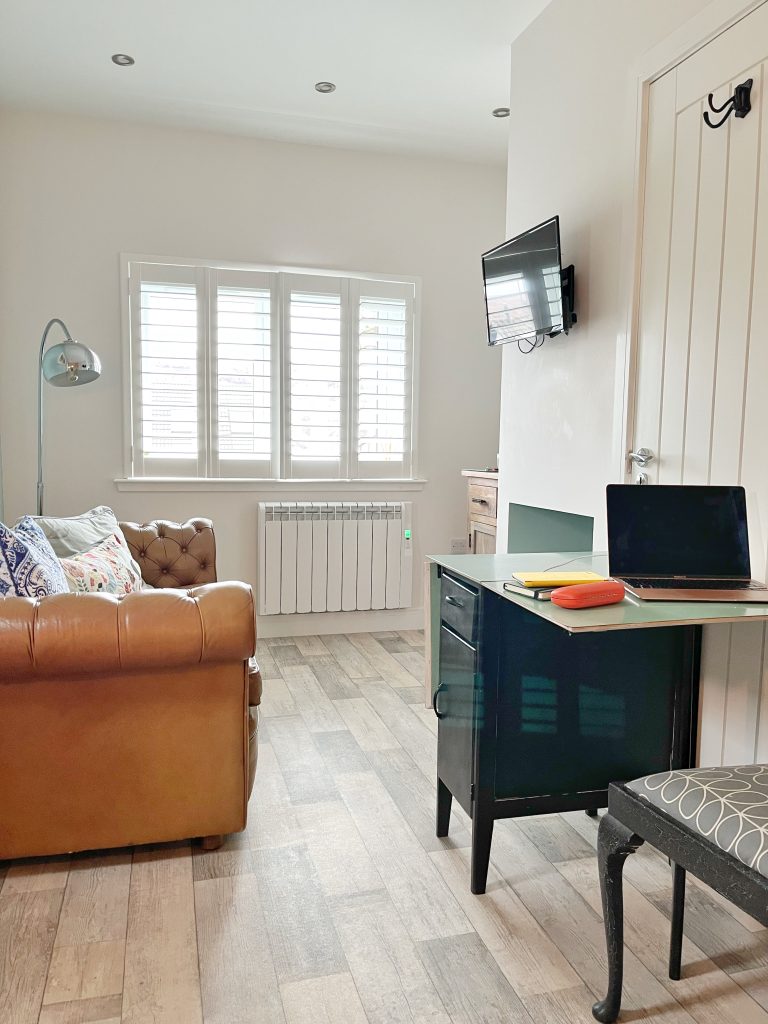
Cupboards are well-stocked with a great selection of tea, coffee (decaf too), hot chocolate, green tea as well as porridge pots to make for breakfast.
For your convenience, there is even a minifridge with loads of milk on hand and Lorna and Brian said that they would supply dairy-free milk too, just send them a message ahead of time. A few biscuits (Tunnocks, of course, the lifeblood of Scotland) were stashed in the cupboard which I was grateful for.
Because I was using the break as a writing retreat, the hosts offered to put a desk and chair into the studio which was so kind and thoughtful! Feel free to message them ahead of time and they’ll do the same for you.
Meals for a writing retreat
With no cooking facilities in the space, I managed to get creative with the kettle and made some noodles, cuppa soups and couscous then stored some cooked chicken, yoghurts and fruit in the mini-fridge.
Plates and cutlery were available too which made it all very simple. Because this was a writing retreat, I was happy to forego cooking any elaborate meals in favour of lots of writing, staring out the window and early nights.

Shower room essentials are on hand; plenty of towels, facecloths, soap, toilet paper and loo cleaner. There was also cleaning supplies, a first aid kit, iron and ironing board, hairdryer, space to hang up clothes, extra blankets (you’re in Scotland, remember!) and bedding is provided.
This shower was SO powerful, I just wanted to mention that because it was honestly better than a lot of hotels I’ve stayed in and made me way more motivated to get up in the morning and start writing early.
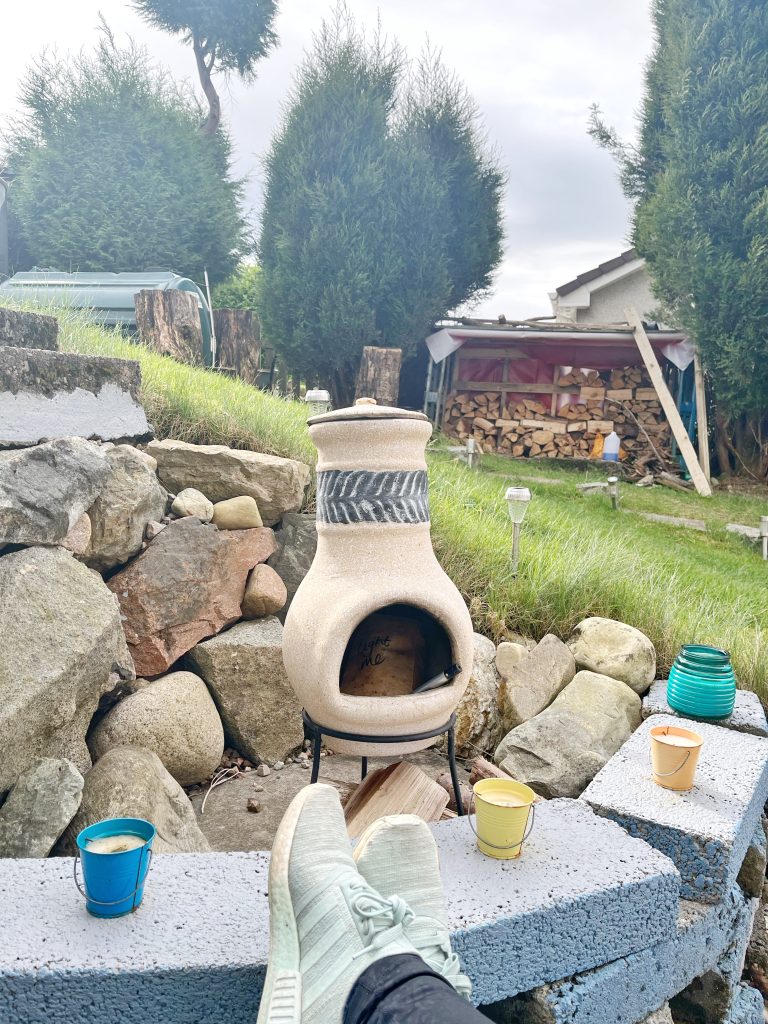
Outside, there is a private seating area where I liked to drink my coffee in the morning. It has space to light a fire and all the tools required to get that going as well.
Essentials to pack
You’ll need to pack toothpaste and shower gel but other than that my rucksack was filled with a few bits of clothing, pyjamas, my Kindle, a notebook, laptop, headphones and some snacks to see me through the first few days of writing.
I popped down to the Tesco on the high street halfway through the week and stocked up on more food to keep me fuelled for the rest of my writing retreat.
Local cafes to eat
Whilst I was in Fort William town I visited Rain Bakery where I had an obscenely delicious toasted goat’s cheese mozzarella pesto grilled sandwich followed by the most beautiful apple streusel danish.
Washed down with a coffee the whole thing set me back about £12 total. I think this might be the best bakery in Scotland.
Next day I went back for another serving. I saw one person sitting with a laptop in the bakery but it is quite a small shop so I wouldn’t recommend going in there to write as I think they would need the tables back pretty quickly as it can get very busy around lunchtime.
Final thoughts
Four nights spent at The Garage in Fort William and am genuinely so sad to leave! The good news is that I managed to write a lot, getting my book ready and into a solid second draft which I’m so happy with. I’m already thinking about booking a summer writing retreat later in 2022.
Hand on heart, I swear I did more writing in those four days than I’ve done in the four weeks leading up to the retreat. It just goes to show the power of a room of one’s own (especially when it has a breathtaking view.)
Follow The Garage on Instagram
Book your writers retreat with Lorna and Brian via Air Bnb
by Fiona likes to blog | Nov 16, 2021 | WRITING
A chance to get creative and write some words with guided exercises you can do from home.
On Wednesday 12th January 2022, 19:00 – 20:30 GMT.
Staring at a blank page with writer’s block is no fun.
Maybe you’ve got an idea for a novel but you’re too scared to sit down and get started.
Perhaps you’ve just finished a story and need a night away from those ideas, a distraction to flex your creative muscles.
It’s taken me years to curate a collection of tools that get me out of a writing funk and back in the flow, and in this workshop I’m going to share some of my favourites!
What to expect:
- A short pep-talk from me about my fiction writing process
- Guided exercises to help you find your voice
- A supportive community to give you the confidence to write more
- A toolbox of writing exercises you can return to again and again
Feeling shy?
Don’t worry, there are no group-based activities or breakout rooms. You won’t be asked to share your work and there is no obligation to turn on your camera or microphone.
Can’t make it?
All ticket holders will get access to a video replay.
Early bird tickets £12 (full price £22)
GET TICKETS


