
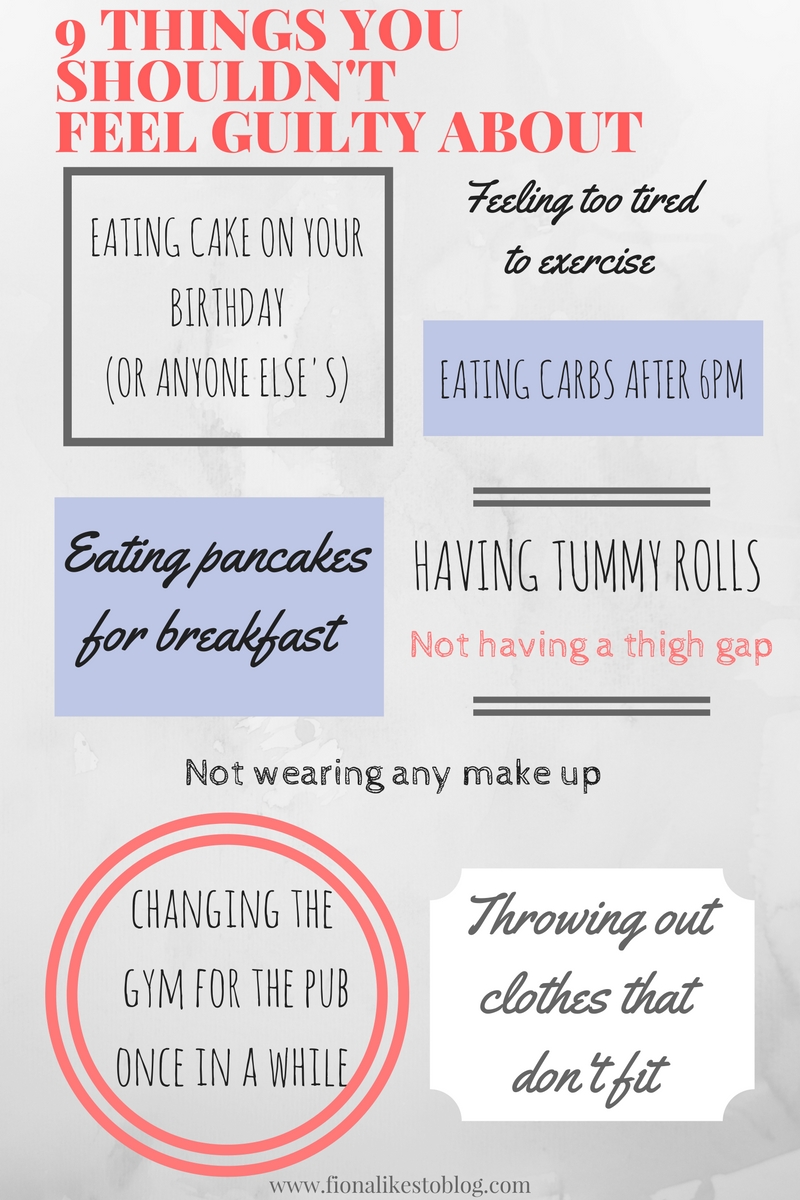
9 things you shouldn’t feel guilty about


Lying curled up in a ball, crying, wondering what the hell you’re going to wear today because nothing looks good. Practically everything you own gives you the dry heaves when you think about ‘body image’. Jeans are too tight. Boobs are too saggy. Arms the flabbiest they’ve ever been. To top it all off you’ve just seen the latest Kim Kardashian beach snaps and she looks phenomenal, having pushed not one but two babies out of her seemingly unaware midriff which gets flatter by the minute.
This is what real women all over the world are going through on a daily basis. We hate every inch of our bodies but many of us really want to change that mentality. We want to learn to love out bodies at ‘any size’, like all the plus size models proclaim. We want to be comfortable flaunting our belly rolls like Megan Jayne Crabbe or bravely strut our stuff in fashionable gear like Felicity Hayward.

The truth is getting to that place of body image acceptance is hard. It’s incredibly hard. Telling that sobbing woman with nothing to wear just to ‘Learn to love your body!’ is so much easier said that done. It’s basically like we are having to retrain our own brains to stop seeing ourselves as unworthy because we don’t look like supermodels or celebrities. I’ve been looking for more practical ways to start building a more positive body image and I wanted to share a few simple tips that you can implement today.
One of the major things that makes my feel shit about my body image is my clothes. If I put something on and it’s a little too tight, or pulls in the wrong places you can guarantee that I’ll automatically start putting tearing myself apart internally with every other outfit I try on.
It’s all well and good keeping hold of clothes because you like the idea of them, or have memories of how they looked on you in the past, but let’s be honest; keeping clothes that don’t fit any more does nothing good for your mental state. It’s like keeping a picture of an ex-boyfriend up on your wall years after you’ve broken up. You’re not fooling anyone. Rip it up and move on.
Instead of trying to make old clothes work for your new body, go shopping and find a style that you’re comfortable with. I’m turning 30 this year and I’ve come to realise that being comfortable is a main priority for me. I like long-sleeved shirts. I like tops to be oversized with a deep V-neck. I like elasticated waists. My best asset is my butt and I’ll be damned if I’m not going to make the most of it.
Get rid of anything that doesn’t make you feel like yourself, or is restricting you in anyway – physically or a otherwise. Throw away everything from your teenage years.

We’re all so overwhelmed with images of the female body it’s inevitably going to contribute to your low self esteem if you’re feeling inadequate. I really enjoy exercise and going to the gym, so over time I’ve followed quite a few Instagram girls who have enviable bodies from working out. Instead of inspiring me to eat well and workout regularly I realised that I was trapping myself in a world of unrealistic expectations, where I never felt like my body was good enough. I was restricting my diet and exercising more and more as a form of punishment, adamant that my gruelling regime would earn me the body I thought I deserved.
The women themselves have beautiful bodies, and I’m not bashing them and what they do for a living – it’s just that their genetics are different to mine. I dieted hard and lost a lot of weight but was exhausted, lacking energy and still nowhere near revealing the washboard abs I dreamt of.
I’ve updated the media I consume by changing my Instagram, Bloglovin, Facebook and Twitter feed to surround myself with healthy messages about body image. I follow plus size models, bloggers and people who promote a more balanced approach to food and exercise.
Trying to love your body the way it is can be testing when magazine headlines still promote crash dieting and taking fat burners for breakfast. We’re all trying to fly the flag for body positivity and although online it can seem like everyone else is on board too, in the real world not many people are talking about themselves in a loving way. Everyone is ‘starting afresh’ on Monday, or calling today a ‘write off’ after an 11am doughnut delivery to the office.

How do we surround ourselves with other strong men and women who believe they are worthy of happiness no matter what their size? I think we can help instigate that change by being verbal about what we believe to everyone we meet.
Sometimes talking to others who are struggling with the same body image issues can highlight how distorted our own views are of ourselves. Listening to friends point out their jiggly bits, wrinkles and grey hairs always takes me by surprise; What are they talking about? I can’t see any of their apparent flaws, in fact I envy their figure and their fabulous dress sense!
This happens all the time, and although I’m sympathetic to the mental turmoil they’re going through (I totally geddit), I always make sure they know why I think they’re beautiful the way they are. The way I see it, if I can get as many people as possible into this new way of thinking, they’ll help support me when I’m feeling low and vice versa. If you can create a community of people who will lift you up then you’re onto a winner.
Are you working towards a more positive body image?

I’ve been blogging solidly without a break for about a month now. That’s a drop in the ocean compared to the celebrity bloggers out there who – after years of hard work – have found internet fame, book deals and personal assistants to do all their flat lay photography for them.
There’s a huge community of us small-time or start up bloggers now and the topic of discussion at the moment seems to be ‘positivity’.
To me, this seems to be the get-out clause for not actually giving an opinion on anything. It’s the broad brushstroke that will cover up bad experiences, feeling marginalised, scrutinised and anything else that could possibly be taken out of context and held against someone to question their character, which in blogging apparently must be squeaky clean.
In a world where our internet presence has become our ‘brand’, and the number of followers we have is what gives that brand ‘value’ it’s understandable why people shy away from talking truthfully about seemingly uncomfortable topics.
I recently read a post by Vix Medrew called Bloggers – Online vs. Real life which is written completely honestly, by a girl who attended an event and was surprised by how some well-known bloggers and You Tube stars acted in real life. She certainly let it all out in this post, and seemed quite angry and disappointed at how the day went down in her eyes.
When this post started doing the rounds on Twitter it really split people into two camps. There were a few famous bloggers retweeting the post, horrified that someone should have a bad word to say about the people who are deemed so ‘perfect’ by most people. Then there were other people saying well done and thanks, thanks for writing about an experience that they too had encountered, but hadn’t wanted to put out there in fear of judgement.
The point is that no one gets to tell you what your truth is, and if it’s not positive then it still needs to be talked about. If Vix says that’s how it went down, then respect to her for getting it off her chest. She probably knew she was going to lose a few followers or upset the odd reader but she wrote it anyway. It’s her opinion on her blog, and she’s entitled to that whether people deem it as unnecessarily negative or otherwise. It opened up a discussion about something that’s vaguely interesting in a world full of Kylie Jenner make up tutorials and bullet journal photographs.
Blogging doesn’t need more positivity, it needs more honesty. If you’re digging that new handbag you bought then blog about it. If it turned out to be crap then write that instead.
If you’re shitting yourself about starting university then blog about it. Don’t write posts about how you have your capsule wardrobe sorted and your carefully selected pineapple stationary to hand. Tell the world how you’re scared you’ll be alone, that you won’t fit in and might get lost on your first day. Because the chances are there’s plenty of people feeling exactly the same and they’re dying to connect with you.
Even if no one comments on your blog, the act of self-expression is important enough for you continue writing truthfully. When you finally let go and share honestly with the world online you will feel so free and more creatively fulfilled than ever before, because you’ve shared something that is unique to you, and that’s what will stick.
What are your thoughts on positivity in the blogging world?

You or someone you know is probably dealing with anxiety, depression or maybe even both. I’ve dealt with both simultaneously for the past 4 years and I’m not yet fully recovered.
I’ve come a long way since the beginning, when I was unable to work and spent every day in bed ignoring phone calls and not eating or washing. My mind was so exhausted that I needed time to recuperate, to recharge before slowly coming to terms with my illness and how it affects my day to day life.
So I wanted to talk about the physical effects of anxiety and depression, from my own experience.It’s something that no one really warned me about, even though I was diagnosed by a doctor and have received treatment for several years. I’m not a qualified mental health expert, but I have lived through it for some time, so maybe it’s of use to you or someone you know who might be suffering.
If you suffer from depression or anxiety then I’m betting you already know how much it hurts. Like, physically hurts. A lot of people don’t realise just how painful mental illness can be, and how much your body can be affected by the chemical changes going on in your brain. I mean, it makes sense. Your brain is the control centre for your entire body, so if it’s having a hard time coping then OF COURSE you’re going to see the consequences of that.
Wondering if your symptoms are normal? Here is a quick rundown of those related to depression thanks to WebMB:
I found that establishing a good self-care routine alongside medication and therapy has been a key part of my recovery. Wondering how to implement some basic self-care? Check out my post below.
If like me, you’re lucky enough to have both depression AND anxiety (#blessed) then here is some more information. Anxiety comes with a whole other set of symptoms, some of which overlap with the previous list and some of which are different. Check out the NHS website for more details and advice.
Check out my tips below on how to deal with some of the most common physical symptoms related to anxiety and depression. You got this!

I spent the first few months in bed like I said, and when I wasn’t sleeping my only interest was going to the gym. A strange response for someone previously uninterested in fitness, but for whatever reason any energy I had I poured into my daily workout. This led me to lose more weight than I ever had previously, a happy side effect as far as I was concerned even if it wasn’t for the right reasons. Not a healthy mindset I’m sure you’ll agree.
After I began taking my prescribed anti-depressants I did experience some weight gain; whether this was a sign of the beginning of recovery or the increased appetite which was described in the pill packet I’m unsure. Overall, I’ve realised that my built in response to both anxious and depressed feelings is to eat. To be honest I’m at a loss as how to shake off this coping mechanism off completely, and it’s definitely attributing to my weight gain as well as low self-esteem which can have a more negative affect on my mental health.
It’s a vicious cycle I’m caught in at the moment without any real idea how to escape it. My way of dealing with it currently is to accept that recovery is a long road, and that changes in my mind and body are to be expected. They are not good or bad, or even permanent. They just exist and will adapt as my health improves over time.

I had anxiety and depression for years before I experienced a panic attack. It wasn’t even something I worried about. I think this is partly because I was too anxious to put myself in a situation difficult enough for it to occur. I’m very wary of new places and unusual social outings and can tell what will freak me out.
This has been a bad way to handle things, because when I did pluck up the courage to do something out of my comfort zone I had a panic attack as a result. The physical symptoms I had were nausea, blurred vision, needing the toilet, feeling faint, racing heart, shortness of breath and excessive sweating. Combine this with the mental symptom of feeling like you are dying and you have pretty terrifying scenario on your hands.
I’ve done some group CBT sessions and the best advice I learned was that you should remain where you are for as long as possible, instead of following the natural urge to leave for somewhere else, somewhere ‘safer’. The panic attack is inside you, not the room, and will subside naturally once you have relaxed.
Interestingly, if you leave the location (e.g. the supermarket) you are more likely to develop an irrational fear of that place because you fear it happening again. So panic attacks lead to more panic attacks; annoying right? The more you focus on your symptoms, the harder it can be to let it pass.
I’ve heard some people say they distract their minds by counting in their heads or remembering something that takes focus like their first car registration. I was alone on a train so I just focused on taking long deep breaths, even though it felt impossible. It did eventually help and I managed to stay on board and it hasn’t affected my ability to use public transport.

When I get anxious I instantly become very self-conscious. This is especially true in social situations where I’m expected to hold a conversation for long periods of time. One of my irrational fears which stems from when I had to leave my job due to depression was that people were going to ask what I did for a living. The answer would then be “Nothing, I’m unemployed because I have depression” a phrase which I was in no way willing to say out loud.
I was so ashamed of myself that I would ask my friends to pre-warn new acquaintances about the reasons of my unemployment so that I wouldn’t have to face the horror of that conversation. Even then, I was still so self-conscious that my entire body felt frozen whilst I floated aimlessly through these social outings. Unless I was plied with alcohol (a terrible decision) I would stare at the floor, hoping no one would ask me a question. If they did I would give a brief answer before turning to my partner or friend who received the usual ‘glare’, suggesting they should hijack the conversation and take it from here.

Ideally, I would stay near the perimeter of a large group of people where I could stand rigid, jaw clenched with my tongue pushed up hard against the roof of my mouth, pretending to listen to whatever the ‘normal people’ were talking about whilst I mentally drifted in and out of the room. This muscular tension which my body seemed to create as a defence mechanism became commonplace.
The one thing that I have found consistently rewarding throughout my depression is exercise. I was the perfect outlet for me to express myself physically, use up the nervous energy that was running through me and loosen up tight muscles. In particular, Pilates, Body Balance, Yoga and Willpower & Grace have all helped me with muscle tension.
If you can afford to go for a spa day and get a massage it will help immensely. It sounds patronising to say a massage will help your depression – it won’t – but it can help soothe the physical pain whilst you continue battle with the mental symptoms.
Have you experienced any of these symptoms?

I spend so much of my life stressed out. Stressed out for reasons that are stupid and pointless for the most part; with my internal voice posing various questions such as “How many toilet rolls do we have left and will I remember to go to the shop for more?” I know, riveting stuff right?
Sometimes I worry about money, my health, how I treat my friends and how often I see my family. Other times I wonder if my life has been memorable. Have done enough good in the world? Then I think about the toilet paper again. So naturally, I need to find ways to calm the chattering voices in my mind, to find some serenity in the madness. Here’s how I do it…
Writing lists is a really straightforward way of offloading thoughts from my mind onto paper. I have an app, diary, journal and a notepad all on rotation depending on where I am and what kind of notes I need to take. I use Google Keep on my mobile to collect all different types of list from a basic ‘to-do’ to blog post ideas, useful websites, research to do, meal ideas and personal mantras.
In my diary I can create bullet point lists for more pressing tasks and assign them to specific days which really helps me relax, because even though I haven’t taken care of ‘the thing’, said thing is now part of my grand plan so it will get done. My notepad is for more elaborate lists, or expanding on ideas and I often use mind mapping (I know, I’m a total geek but I’m cool with it) to come up with ideas for my blog.
My journal is reserved for those times when I have a barrage of negative thoughts filling up in my mind. Like an overstuffed suitcase I need to take out the excess and discard it somewhere safe. In my journal I write completely honestly, knowing that no one will ever read it, and I often start without an idea of what I actually want to say. This can lead me down a rabbit hole, but a cathartic one nonetheless, that ideally ends in some sort of resolution or at least identification of a problem that can be worked on in the future.
It might sound obvious but how many times do you actually sit and relax without your phone nearby? I often find myself in the middle of something important, like writing this blog post, only to hear that familiar ‘bing’ that instantly lures my attention away to whatever is happening on social media.
Is losing my train of thought really worth it to find out that someone liked my latest Instagram post? Probably not. If I’m feeling overwhelmed it can be really good for me to pull a curtain over the world of the internet and just be in my own space for a while. It allows me to really focus on one task at a time – surprisingly difficult for me – without that niggling feeling that I might be needed elsewhere.
It’s no secret that exercise is my number one form of stress relief. I get cranky when I haven’t worked out for a few days and I feel instantly renewed when I finally do hit the gym, take a class or even just enjoy a long walk in the fresh air.
Not everyone thinks of high intensity exercise as a way to relax, but for me it’s like the fitness equivalent of ‘giving myself a shake’, realising that things aren’t as impossible as they seem and it can put pointless worries into perspective. Doing demanding moves like burpees and tuck jumps is a way of getting out of my own head.
For an introvert like me it’s also a great way to socialise with others indirectly without too much anxiety. Since moving to a new gym I’ve also been doing yoga regularly and I can really see the benefits. Physically it’s an invaluable tool for relaxing muscles that you didn’t even realise were tense, and mentally it’s perfect for forcing those racing thoughts elsewhere whilst you focus on breathing and holding challenging poses. Although most classes last an hour, apps like Down Dog offer short sessions that can be done at home and act as an instant way to clear your head.
What are your tips for decluttering your mind?

Live to work or work to live? Most people have a strong opinion on this topic. I know it’s highly unlikely that everyone out there can go and find their dream job and love what they do every single day – but I’ve worked long enough in various jobs I detest to know that no one should be told it’s not worth trying for. I
f you find something you love, you should absolutely aim to do that thing everyday even if it’s just a hobby. If you’re lucky, your passion for that hobby might turn into a job without even trying.
It was really important for me to take time off from my day job to realise that I didn’t want to do it anymore. I know most people don’t love what they do, but I seriously didn’t enjoy the responsibility and stress that came with my job as a manager. It took its toll on my relationships, mental and physical health, and made me unhappy in so many ways that it went way beyond the usual ‘my job sucks’ kinda situation.
Unfortunately I was so sick from work I had to take a lot of unpaid time off, but I urge others to take some holidays in general to have time for reflection. It’s too easy to take a week off to fly to a hot country, drink too much and then fall back down to earth with a bang when you return to work.
Set aside some time to write down what you want from a job, or even just a hobby; anything that you think will give a sense of purpose to your days. Think about the things you enjoy when you’re off work. What do you look forward to? What could you see yourself doing? What could you do everyday that wouldn’t feel like a job, but instead something you jump out of bed for and have to do?
I know that writing is perfect for me because my ideas keep me up at night. I get so engrossed that I forget to eat and when I’m typing away getting up to go to the bathroom is an inconvenience! If you can’t think of anything that gets you excited, that’s OK too. My advice is to first stop wasting energy on something you know you hate, because it leaves you very little left in the tank to pursue what does make you happy.
The most common reason I hear for not chasing your dream is “I’m not talented enough” or “I don’t know how”. If this sounds like you then I strongly advise you take a class to find out just how talented you really are. Over the years I’ve gladly taken part in at any extra training provided in my workplace in the form of first aid and management courses. In the evenings I’ve done several writing courses as well as a gym instructor course and an introduction to counselling.
I’ve struggled more than anyone to try and pin down what it is I want to do with my life, and even though many of these training exercises haven’t led to new career paths they’ve enriched my life, given me added skills and if nothing else helped me cross another potential option off the list.
I remember vividly the day I quit my first coffee shop management job. My area manager wished me all the best, and as I told her I wasn’t cut out for leadership she loudly proclaimed “But you’re so good at it!” much to my embarrassment and brief feeling of regret.
I think that was when I realised that I had spent 2 years doing a job I despised purely because I was so flattered that other people thought I was good enough to do it. With every promotion I felt fear and a sense of worth in equal measure. Obviously the small pay rise offered a tempting reward but I honestly think the sense of accomplishment was what kept me chasing the next new title on my name badge.
But after the congratulations had been passed around, the real work began and I was left feeling empty and more stressed than before. The point is, it’s all about balance. We’ve all got to make enough money to live comfortably, but sometimes doing 50 hours a week to earn a good wage makes life uncomfortable in other ways.
Sometimes working for less money doing something you enjoy offers a more fulfilling lifestyle overall; it’s not particularly well-paid but its not horribly soul-destroying either. Balance!
What steps have you taken to find your passion?


